PARROTS Psittacidae |
|
 The Parrots are a very large family of easily recognized birds, generally restricted to the tropics around the globe. They range from huge macaws, exemplified by the spectacular Scarlet Macaw of the Neotropics (above) to tiny parrotlets and lovebirds, represented here by a pair of Rosy-faced Lovebirds (left) from southwestern Africa. Parrots are a vast and interesting lot. It seems clear that they are distinct from other types of birds, and yet there has been much debate about their relationships. The most recent evidence tends to split the psittiformes into 3 or 4 families. For the moment, I follow here the approach used by Christidis & Boles (2008) and set out three families: the Nestoridae [three New Zealand parrots], the Cacatuidae [Cockatoos], and the rest of them here, in the Psitticidae. The division between cockatoos and the rest has been in place for a decade (e.g., Collar 1997), but the split of the New Zealand set is new. It may be that lories and lorikeets are a distinct lineage, but the parameters are not well resolved, so for now they are a subfamily (Loriinae). The remaining Psittacidae has 181 species in the Old World, and 148 species in the New World. The Parrots are a very large family of easily recognized birds, generally restricted to the tropics around the globe. They range from huge macaws, exemplified by the spectacular Scarlet Macaw of the Neotropics (above) to tiny parrotlets and lovebirds, represented here by a pair of Rosy-faced Lovebirds (left) from southwestern Africa. Parrots are a vast and interesting lot. It seems clear that they are distinct from other types of birds, and yet there has been much debate about their relationships. The most recent evidence tends to split the psittiformes into 3 or 4 families. For the moment, I follow here the approach used by Christidis & Boles (2008) and set out three families: the Nestoridae [three New Zealand parrots], the Cacatuidae [Cockatoos], and the rest of them here, in the Psitticidae. The division between cockatoos and the rest has been in place for a decade (e.g., Collar 1997), but the split of the New Zealand set is new. It may be that lories and lorikeets are a distinct lineage, but the parameters are not well resolved, so for now they are a subfamily (Loriinae). The remaining Psittacidae has 181 species in the Old World, and 148 species in the New World. |
 |
The Hyacinth Macaw feeds on the fruits of a small number of palms, and is quite local in the wild; fine articles on finding this wonderful bird in the Brazilian Pantanal are Ridgely (1983) and Whittingham et al. (1998). The Colasisi, a Philippine endemic, has a brush-tipped tongue adapted to eating nectar. Very few parrots in the Psitticinae assemblage have this adaptation. |
Other colorful small parrots in this region, by outside the Loriinae, include six species of pygmy-parrots (Micropsitta) — the smallest parrots in the world — found only in New Guinea and adjacent islands (the Moluccas to the Solomons); six species of fig-parrots in 3 genera, five of them restricted to New Guinea and adjacent islands (one barely reaches n.e. Australia) and the Guaiabero Bolbopsittacus lunulatus of the Philippines. One of the most ancient parrots may be Vulturine (Presquet's) Parrot Psittrichas fulgidus of New Guinea is in a monotypic tribe; it is a large and ungainly dark-headed, red-bellied parrot of the highlands, moving in small flocks, and is one of the highly sought-after species there by birders. It is often placed in its own subfamily or tribe. |
Another tribe [Platycercini, according to Collar 1997] includes many of the famous Australasian parrots, including Budgerigar Melopsittacus undulatus from which the many varieties of pet "Budgies" have been bred. These are 37 species in 14 genera, and many are found in Australia's eucalyptus forest or the dry interior. Among these is the local Superb Parrot (right). The famed Paradise Parrot Psephotus pucherrimus of interior eastern Australia, once bred in termite mounds. It apparently went extinct about the mid 20th century; there are photos of wild birds, adding to the poignancy. The Night Parrot Geopsittacus occidentalis of the arid interior has also been thought to be near extinction, but there is recent evidence that it still survives. |
|
 |
|
|
 |
| Other impressive spectacles are at the unique and local natural "salt licks" (salidas) that attract parrots early and late in the day to eroded cliff-faces along some South American rivers. This salt lick (above) — shot from a moving small boat on the Napo River, e. Ecuador — is full of the large, very pale-headed & pale-backed Mealy Parrots (with yellow tails); the small dark-green Blue-headed Parrots (with their all-blue heads); and the mid-sized medium-green Yellow-crowned Parrots (a few very similar Orange-winged Parrots were also present, but the photo is a bit too fuzzy to pick them out). |
|
In the Caribbean, four species of Amazon parrots are making comebacks as the island nations find that parrots bring in tourists. especially the four species in the Lesser Antilles: single species on St. Lucia and St. Vincent, and two on Dominica. The latter two are limited to the primeval forest on Mt. Diablotins, where the Red-necked Amazon (right) occurs at lower elevations while the rarer Imperial Amazon Amazona imperialis is up higher in the cloud forest. There are perhaps only 150 birds remaining, but the population is no longer in steep decline. During our 1999 trip to Brazil, we also visited Rio Cristalino Lodge in the heart of the Amazon Basin. There we observed one of the newly described species of parrots — Kawall's or White-faced Amazon A. kawalli — which was only recognized as a different species in 1989. Along this rapidly-flowing blackwater stream it replaces Mealy Parrot, which is otherwise widespread in the steaming Amazon lowlands. And speaking of the newly-described Kawall's Parrot reminds me of Stap's (1991) book about the LSU expeditions by John O'Neill and the late, great Ted Parker to eastern Peru: A Parrot without a Name: The Search for the Last Unknown Birds on Earth. It tells a fascinating story of discovery, including a new parrotlet "without a name" on a 1985 adventure [eventually described to science as the Amazonian Parrotlet Nannopsittaca dachilleae (O'Neill et al. 1991)]. |
 While my Neotropical parrot discussion has been dominated by macaws and big Amazona parrots, the New World tropics are full of a variety of parakeets, conures, and parrotlets. Parrots evolved in forests and remain closely linked to them today. Most species nest in hollow trees or old woodpecker holes (or the occasional cave in rocky habitat). A few species, though, both in the New World and in Australia, nest primarily in termite mounds (termitarias). The Peach-fronted Parakeet (left) is one of a pair using this huge arboreal termitaria in s. Brazil. These species have learned to dig their own nest holes into the (comparatively) soft substrate of the termite nest. While my Neotropical parrot discussion has been dominated by macaws and big Amazona parrots, the New World tropics are full of a variety of parakeets, conures, and parrotlets. Parrots evolved in forests and remain closely linked to them today. Most species nest in hollow trees or old woodpecker holes (or the occasional cave in rocky habitat). A few species, though, both in the New World and in Australia, nest primarily in termite mounds (termitarias). The Peach-fronted Parakeet (left) is one of a pair using this huge arboreal termitaria in s. Brazil. These species have learned to dig their own nest holes into the (comparatively) soft substrate of the termite nest. |
Throughout the world's tropical forests, parrots amuse and amaze. One is often awe-struck by their beauty amidst a backdrop of jungle: check out this Blue-naped Parrot (right) on the island of Mindoro in the Philippines. I can do little more here than encourage you to seek them out and to enjoy as harbingers of the wild. |
Photos: The flying Scarlet Macaw Ara macao was at Rio Tigre, Osa Peninsula, Costa Rica, on 26 Dec 2007. The pair of Peach-faced (Rosy-faced) Lovebird Agapornis roseicollis were at Spitzkoppe, Namibia, on 17 July 2005. The Hyacinth Macaw Anodorhynchus hyacinthinus was in the Brazilian Pantanal on 5 Aug 1999. Blake Matheson photographed the Colasisi (Philippine Hanging-Parrot) Loriculus philippensis on Mt. Katanglad, Mindanao, Philippines, in Dec 2005. Murray Lord photographed the Rainbow Lorikeet Trichoglossus haematodus at Grafton, Australia, in Dec 2006. The Superb Parrot Polytelis swainsonii was in the Gulpa Forest Reserve, New South Wales, Australia, on 31 Dec 1997. The wild but very tame Crimson Rosella Platycercus elegans was at O'Reilly's Guesthouse in Lamington Nat'l Park, Queensland, Australia, in Nov 1983. The girl feeding a Crimson Rosella and an Australian King Parrot Alisterus scapularis was at Badger Weir Park, Victoria, Australia, in Jan 1998. The Gray-headed Lovebird Agapornis canus was north of Tulear, sw. Madagascar, in Nov 1992. The Rose-ringed Parakeet Psittacula krameri was at Bharatpur, India, on 19 Aug 1978. The African Gray Parrot Psittacus erithacus was over Belinga Rd., Gabon, in July 1996. Rita Carratello was making friends with a pet Blue-fronted Amazon Amazona aestiva in the Brazilian Pantanal in August 1999. Visiting the salt lick on the Napo River, e. Ecuador (near La Selva Lodge) in Apr 1992 were Blue-headed Parrots Pionus menstruus, Mealy Parrots Amazona farinosa, and Yellow-crowned Amazons A. ochrocephala. The Red-necked Amazon A. arausiaca was on Dominica, Lesser Antilles, on 24 Mar 2000. The nesting Peach-fronted Parakeet Aratinga aurea was in the Serra de Araras, Mato Grosso, Brazil, in Aug 1999. The Blue-naped Parrot Tanygnathus lucionensis was on Mindoro, Philippines, on 7 Dec 2005. All photos © Don Roberson, except the Colasisi © Blake Matheson and the Rainbow Lorikeet © Murray Lord, and used with permission; all rights reserved. |
Saturday, May 22, 2010
Cute Parrots pics 2010
 Some are among the most spectacular birds in the world, including the Hyacinth Macaw (above) of the Pantanal region of south-central South America. It is the world's largest parrot at 100 cm (~40") long and 1.7 kg (=3.75 lb) in weight, some 170 times heavier and twelve times longer than one of the New Guinea pygmy-parrots (Collar 1997). I don't have a photo of a pygmy-parrot, but the Colasisi of the Philippines (right, in a fine photo by Blake Matheson) is pretty small — although the pygmy-parrots are smaller still.
  It is the lorikeets and lories, often placed in a subfamily [Loriinae] and sometimes considered their own family (e.g., Clements 1991), that are known for their brush-tipped, nectar-feeding tongues. This Rainbow Lorikeet (left, in a great shot by Murray Lord) is feeding on flowers with that adaptation. There are 53 species in a dozen genera, all confined to Australasia, eastern Indonesia, or remote South Pacific islands. Some are abundant and widespread, like the Rainbow Lorikeet, but many others are scarce and local.
 Fortunately, many Australasian parrots are common and widespread, such as Crimson Rosella (left) in eastern Australia. At places like O'Reilly's, in Lamington Nat'l Park, Queensland, or Badger Weir park in Victoria, these wild rosellas have become very tame and will eat out of your hand (below). At the latter spot, so will Australian King Parrot (below on the girl's left hand), a species that shows strong sexual dimorphism. King parrots are listed in the tribe Psittaculini by Collar (1997), among a wide variety of parrots: 66 species in a dozen genera in Africa and Asia. Among this diversity are nine species of racquet-tail (genus Prioniturus), ranging from the Philippines to the Moluccas, and 8 species of Agapornis lovebirds in Africa, plus one on Madagascar (Gray-headed Lovebird, inset below).
 The tribe Psittaculini includes the genus Psittacula (14 species), represented here by the Rose-ringed Parakeet (left) which has a wide distribution from sub-Saharan Africa to se. China. Parrots in this genus have reached the remote islands in the Indian Ocean; two have gone extinct (in the Seychelles and on Rodrigues) but the Mauritius Parakeet P. echo continues to cling to existence. In November 1992 we saw 8 of 20 birds still left in the wild. There is a small captive breeding program underway that adds some hope for the species' survival. Also in this group is the famous African Gray Parrot (inset below) of the Congo Basin to west Africa. It is considered the best "talking" parrot of them all. In truly wild country, African Grays gather in communal roosts for the evening; up to 10,000 have been counted in a roost in Gabon (Collar 1997). Just imagine that sound!
 While the Old World has two subfamilies and 7 tribes of parrots, at least as arranged by Collar (1997), the New World has but a single tribe in a single subfamily [the Arini] yet among these 148 species is an astonishing variety in size, shape, and behavior. About 30 species are in the widespread New World genus Amazona; these include some of the Neotropics commonest parrots and some of the world's rarest species. "Amazon" parrots are often kept as pets; indeed, in past centuries explorers coming upon previously undiscovered native inhabitants often found they kept pet parrots in their villages. At right Rita is holding a Blue-fronted (or Turquoise-fronted) Amazon which was a pet of a local family in the Brazilian Pantanal; they had found it as a baby fallen out of its nest hole and raised it to adulthood. Such parrots can live 20-30 years. The evening flight of wild Blue-fronts in the Pantanal is truly an impressive spectacle.
 Man has had a long history of association with parrots. Obviously, keeping parrots as pets is a major hobby. Our fascination with parrots is not limited to their beauty and unique bill, but a number of species are good mimics and can be taught to "talk." The illegal trade in wild parrots has decimated some wonderful species. Spix's Macaw Cyanopsitta spixii became extinct in the wild when the last lonely male living in the wild in eastern Brazil disappeared in 2000. Fortunately, the trade in wild macaws is declining, and some populations are rebounding. Great Green Macaw (pair in flight, left), a Vulnerable species ranging patchily from Honduras to Ecuador, is now rebounding in eastern Costa Rica. Local naturalists are paying landowners to leave standing the huge wild almond (Dipteryx) trees where it nests, and have made poaching unfashionable. The macaws are responding with increased productivity.
 Yet many species remain threatened by this commerce. The Red-and-blue Lory Eos histrio of islands north of Sulawesi is currently being "vacuumed" out of existence by a wild parrot trade. In one California-sized area of Bolivia, trappers in 1975-1984 essentially wiped out all large macaws. Collar (1997) has a fine summary of the impact on psittacines by illegal smuggling, plus the hope for the future with strengthened international laws and protocols.
 Most parrots pair for life, and form monogamous pair bonds. Courtship displays often include vocalizations and tail-fanning; the impressive Red-fan Parrot Deroptyus accipitrinus of the Amazon Basin has an erectile ruff that frames the head with bright red and blue bands.
Cute Parrots pics 2010
PARROTS Psittacidae |
|
| The Parrots are a very large family of easily recognized birds, generally restricted to the tropics around the globe. They range from huge macaws, exemplified by the spectacular Scarlet Macaw of the Neotropics (above) to tiny parrotlets and lovebirds, represented here by a pair of Rosy-faced Lovebirds (left) from southwestern Africa. Parrots are a vast and interesting lot. It seems clear that they are distinct from other types of birds, and yet there has been much debate about their relationships. The most recent evidence tends to split the psittiformes into 3 or 4 families. For the moment, I follow here the approach used by Christidis & Boles (2008) and set out three families: the Nestoridae [three New Zealand parrots], the Cacatuidae [Cockatoos], and the rest of them here, in the Psitticidae. The division between cockatoos and the rest has been in place for a decade (e.g., Collar 1997), but the split of the New Zealand set is new. It may be that lories and lorikeets are a distinct lineage, but the parameters are not well resolved, so for now they are a subfamily (Loriinae). The remaining Psittacidae has 181 species in the Old World, and 148 species in the New World. |
|
The Hyacinth Macaw feeds on the fruits of a small number of palms, and is quite local in the wild; fine articles on finding this wonderful bird in the Brazilian Pantanal are Ridgely (1983) and Whittingham et al. (1998). The Colasisi, a Philippine endemic, has a brush-tipped tongue adapted to eating nectar. Very few parrots in the Psitticinae assemblage have this adaptation. |
Other colorful small parrots in this region, by outside the Loriinae, include six species of pygmy-parrots (Micropsitta) — the smallest parrots in the world — found only in New Guinea and adjacent islands (the Moluccas to the Solomons); six species of fig-parrots in 3 genera, five of them restricted to New Guinea and adjacent islands (one barely reaches n.e. Australia) and the Guaiabero Bolbopsittacus lunulatus of the Philippines. One of the most ancient parrots may be Vulturine (Presquet's) Parrot Psittrichas fulgidus of New Guinea is in a monotypic tribe; it is a large and ungainly dark-headed, red-bellied parrot of the highlands, moving in small flocks, and is one of the highly sought-after species there by birders. It is often placed in its own subfamily or tribe. |
Another tribe [Platycercini, according to Collar 1997] includes many of the famous Australasian parrots, including Budgerigar Melopsittacus undulatus from which the many varieties of pet "Budgies" have been bred. These are 37 species in 14 genera, and many are found in Australia's eucalyptus forest or the dry interior. Among these is the local Superb Parrot (right). The famed Paradise Parrot Psephotus pucherrimus of interior eastern Australia, once bred in termite mounds. It apparently went extinct about the mid 20th century; there are photos of wild birds, adding to the poignancy. The Night Parrot Geopsittacus occidentalis of the arid interior has also been thought to be near extinction, but there is recent evidence that it still survives. |
|
|
|
|
|
| Other impressive spectacles are at the unique and local natural "salt licks" (salidas) that attract parrots early and late in the day to eroded cliff-faces along some South American rivers. This salt lick (above) — shot from a moving small boat on the Napo River, e. Ecuador — is full of the large, very pale-headed & pale-backed Mealy Parrots (with yellow tails); the small dark-green Blue-headed Parrots (with their all-blue heads); and the mid-sized medium-green Yellow-crowned Parrots (a few very similar Orange-winged Parrots were also present, but the photo is a bit too fuzzy to pick them out). |
|
In the Caribbean, four species of Amazon parrots are making comebacks as the island nations find that parrots bring in tourists. especially the four species in the Lesser Antilles: single species on St. Lucia and St. Vincent, and two on Dominica. The latter two are limited to the primeval forest on Mt. Diablotins, where the Red-necked Amazon (right) occurs at lower elevations while the rarer Imperial Amazon Amazona imperialis is up higher in the cloud forest. There are perhaps only 150 birds remaining, but the population is no longer in steep decline. During our 1999 trip to Brazil, we also visited Rio Cristalino Lodge in the heart of the Amazon Basin. There we observed one of the newly described species of parrots — Kawall's or White-faced Amazon A. kawalli — which was only recognized as a different species in 1989. Along this rapidly-flowing blackwater stream it replaces Mealy Parrot, which is otherwise widespread in the steaming Amazon lowlands. And speaking of the newly-described Kawall's Parrot reminds me of Stap's (1991) book about the LSU expeditions by John O'Neill and the late, great Ted Parker to eastern Peru: A Parrot without a Name: The Search for the Last Unknown Birds on Earth. It tells a fascinating story of discovery, including a new parrotlet "without a name" on a 1985 adventure [eventually described to science as the Amazonian Parrotlet Nannopsittaca dachilleae (O'Neill et al. 1991)]. |
| While my Neotropical parrot discussion has been dominated by macaws and big Amazona parrots, the New World tropics are full of a variety of parakeets, conures, and parrotlets. Parrots evolved in forests and remain closely linked to them today. Most species nest in hollow trees or old woodpecker holes (or the occasional cave in rocky habitat). A few species, though, both in the New World and in Australia, nest primarily in termite mounds (termitarias). The Peach-fronted Parakeet (left) is one of a pair using this huge arboreal termitaria in s. Brazil. These species have learned to dig their own nest holes into the (comparatively) soft substrate of the termite nest. |
Throughout the world's tropical forests, parrots amuse and amaze. One is often awe-struck by their beauty amidst a backdrop of jungle: check out this Blue-naped Parrot (right) on the island of Mindoro in the Philippines. I can do little more here than encourage you to seek them out and to enjoy as harbingers of the wild. |
Photos: The flying Scarlet Macaw Ara macao was at Rio Tigre, Osa Peninsula, Costa Rica, on 26 Dec 2007. The pair of Peach-faced (Rosy-faced) Lovebird Agapornis roseicollis were at Spitzkoppe, Namibia, on 17 July 2005. The Hyacinth Macaw Anodorhynchus hyacinthinus was in the Brazilian Pantanal on 5 Aug 1999. Blake Matheson photographed the Colasisi (Philippine Hanging-Parrot) Loriculus philippensis on Mt. Katanglad, Mindanao, Philippines, in Dec 2005. Murray Lord photographed the Rainbow Lorikeet Trichoglossus haematodus at Grafton, Australia, in Dec 2006. The Superb Parrot Polytelis swainsonii was in the Gulpa Forest Reserve, New South Wales, Australia, on 31 Dec 1997. The wild but very tame Crimson Rosella Platycercus elegans was at O'Reilly's Guesthouse in Lamington Nat'l Park, Queensland, Australia, in Nov 1983. The girl feeding a Crimson Rosella and an Australian King Parrot Alisterus scapularis was at Badger Weir Park, Victoria, Australia, in Jan 1998. The Gray-headed Lovebird Agapornis canus was north of Tulear, sw. Madagascar, in Nov 1992. The Rose-ringed Parakeet Psittacula krameri was at Bharatpur, India, on 19 Aug 1978. The African Gray Parrot Psittacus erithacus was over Belinga Rd., Gabon, in July 1996. Rita Carratello was making friends with a pet Blue-fronted Amazon Amazona aestiva in the Brazilian Pantanal in August 1999. Visiting the salt lick on the Napo River, e. Ecuador (near La Selva Lodge) in Apr 1992 were Blue-headed Parrots Pionus menstruus, Mealy Parrots Amazona farinosa, and Yellow-crowned Amazons A. ochrocephala. The Red-necked Amazon A. arausiaca was on Dominica, Lesser Antilles, on 24 Mar 2000. The nesting Peach-fronted Parakeet Aratinga aurea was in the Serra de Araras, Mato Grosso, Brazil, in Aug 1999. The Blue-naped Parrot Tanygnathus lucionensis was on Mindoro, Philippines, on 7 Dec 2005. All photos © Don Roberson, except the Colasisi © Blake Matheson and the Rainbow Lorikeet © Murray Lord, and used with permission; all rights reserved. |


Elephant List
7:30 p.m., Historic Arkansas Museum. $12-$14.
After their successful collaboration on the musical “Quilters,” the Historic Arkansas Museum and the Community Theatre once again join together to present a stage play in the museum's theater. Set outside a sod hut in the wilds of Kansas in the 1870s, “Going to See the Elephant” focuses on four frontier women: Ma, who's always dishing out homespun wisdom; Sara, her content daughter-in-law; Etta, a young girl still traumatized after being abducted by Cheyenne, and Mrs. Nichols, a refined lady from the East forced to remain on the frontier while her husband recovers from illness. As they battle wolves and worry over Indian attacks, they talk of “going to see the elephant” or “crossing the next hill to see what lies on the other side.” Performances are at 7:30 p.m. Feb. 22, 23, 29 and March 1, and 2 p.m. Feb. 24 and March 2.
 Elephant
 Elephant
 Elephant
 Elephant
 Elephant
Saturday, December 5, 2009
world top eagles
 eagle
eagle american eagle
 fast eagle
 flying eagle
 eagle
eagle
Friday, December 4, 2009
king cobra

Profile
The King Cobra is a large and powerful snake, averaging 3.6–4 m (12–13 feet) in length and  typically weighing about 6 kg (13.2 lb). A particularly large specimen was kept captive at the London Zoo and grew to 5.7 m (18.8 ft) before being euthanized upon the outbreak of World War II.[5] The skin is either olive-green, tan, or black and it has faint, pale yellow cross bands down the length of the body. The belly is cream or pale yellow, and the scales are smooth. The head of a mature snake can be quite massive and bulky in appearance, though like all snakes, they can expand their jaws to swallow large prey items. It has proteroglyph dentition, meaning it has two short, fixed fangs in the front of the mouth which channel venom into the prey like hypodermic needles. The male is larger and thicker than the female. The average lifespan of a King Cobra is about 20 years.
Habitat

Widespread, but not common, across South and South-east Asia. It lives in dense highland forests.[1][6] The snake has a preference for living in areas dotted with lakes and streams. King Cobra populations have dropped in some areas of its range due to the destruction of forests, but despite this the snake is not listed by the IUCN as in danger of becoming extinct. It is, however, listed as an Appendix II Animal within CITES
Hunting
King Cobras, like other snakes, receive chemical information (“smell”) via their forked tongues, which pick up scent particles and transfer them to a special sensory receptor (Jacobson's Organ) located in the roof of its mouth.[1] When the scent of a meal has been detected, the snake will flick its tongue to gauge the prey's direction (the twin forks of the tongue acting in stereo); it will also rely on its keen eyesight (King Cobras are able to detect moving prey almost 100 m [300 feet] away), intelligence[8] and sensitivity to earth-borne vibration to track its prey.[9] Following envenomation, the King Cobra will begin to swallow its struggling prey while its toxins begin the digestion of its victim.[1] King Cobras, as with all other snakes, do not have rigidly fixed jaws. Instead, the jaw bones are connected by extremely pliable ligaments, enabling the lower jaw bones to move independently of each other.[1] Like other snakes, the King Cobra does not chew its food, instead it swallows its prey whole. The expansion of the jaw enables the snake to swallow prey much larger than its head.[1]
King Cobras are able to hunt at all times of day, although it is rarely seen at night, leading most herpetologists to classify it as a diurnal species
Diet
The King Cobra's diet is mainly composed of other snakes (ophiophagy): both non-venomous snakes such as pythons and venomous snakes including kraits[2][10] When food is scarce, King Cobras may also feed on other small vertebrates such as lizards, birds, and rodents. In some cases, the cobra may “constrict” its prey, like birds and larger rodents using its muscular body, though this is uncommon.[1][10] After a large meal the snake may live for many months without another one due to its slow metabolic rate.[1]
The King Cobra's favourite meal is the Ratsnake, which feeds on rats, this leads King Cobras near human settlements as rats are drawn to human settlements, Ratsnakes follow the rats and King Cobras follow the Ratsnakes.
Defense

If a King Cobra encounters a natural predator, such as the mongoose, which has some resistance to the neurotoxins,[12] the cobra will generally try to flee. If all else fails, it will flatten its upper body by spreading its ribs, forming the distinctive cobra hood about its neck, which can be the size of an adult's handspan. It will also emit a high-pitched hiss, sometimes with feigned closed-mouth strikes. These efforts usually prove to be very effective, especially since the King cobra is more dangerous than other mongoose prey as well as being much too
large for the small mammal to kill.

Venom
The King Cobra's venom, which is composed mostly of proteins and polypeptides, is produced in specialized salivary glands (as is the case with all venomous reptiles) just behind the animal's eyes. When biting its prey, venom is forced through the snake's half-inch (1.25 cm) fangs and into the wound. Although its venom is not the most toxic one, a King Cobra's size enables it to inject larger quantities of venom than most other species. On a single bite, it injects as much as 6 to 7 ml of venom.[13][14] The large amount of venom in a single bite allows the King Cobra to kill faster and to kill larger animals than other serpents. The King Cobra can kill up to five times faster than the black mamba, so it just takes a few minutes to kill a human, and it can even kill an Asian Elephant within three hours if the larger animal is bitten in a vulnerable area such as the trunk. [15][16]
The King Cobra's venom is primarily neurotoxic and thus attacks the victim's central nervous system and quickly induces severe pain, blurred vision, vertigo, drowsiness, and paralysis.[13] In one to two minutes, cardiovascular collapse occurs, and the victim falls into a coma. Death soon follows due to respiratory failure. There are two types of antivenin made specifically to treat King Cobra envenomations. The Red Cross in Thailand manufactures one, and the Central Research Institute in India manufactures the other; however, both are made in small quantities and are not widely available.[17] Ohanin, a protein component of the venom, causes hypolocomotion and hyperalgesia in mammals.[18] Other components have cardiotoxic,[19] cytotoxic and neurotoxic effects.[20]
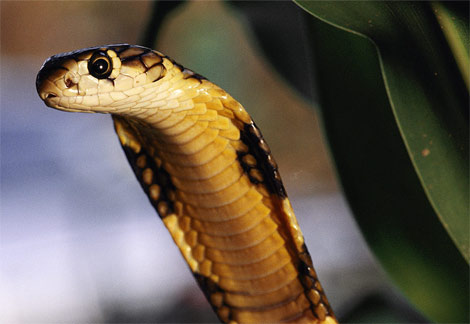
Despite the King Cobra's fearsome reputation and deadly bite, it is a shy and reclusive animal, avoiding confrontation with humans as often as possible.[10]Monocled Cobra, or Russell's Viper .[6] There are other venomous snakes within this species' range, in fact, that are responsible for more fatal snake bites than the King Cobra, such as the
In Burma, King Cobras are often used by female snake charmers.[10] The charmer is usually tattooed with three pictograms using an ink mixed with snake venom; superstition holds that it protects the charmer from the snake.[10] The charmer kisses the snake on the top of its head at the end of the show
Reproduction
The female king cobra is a very dedicated parent. Before she is ready to lay her eggs, she uses the coils of her long body to gather a big mound of leaf litter. She deposits 20–40 eggs into the mound, which acts as an incubator. The female stays with her eggs and guards the mound tenaciously, rearing up into a threat display if any large animal gets too close.

Inside the mound that the female has built the eggs are incubated at a steady 28℃. When the eggs start to hatch, instinct causes her to leave the nest and find prey to eat so that she does not eat her young.